
Air Compressor for Spray Painting: PSI, CFM, HP & Tank Size Explained
- Taruu
- Spray Painting Air Compressor
- Air Compressor for Spray Painting: PSI, CFM, HP & Tank Size Explained
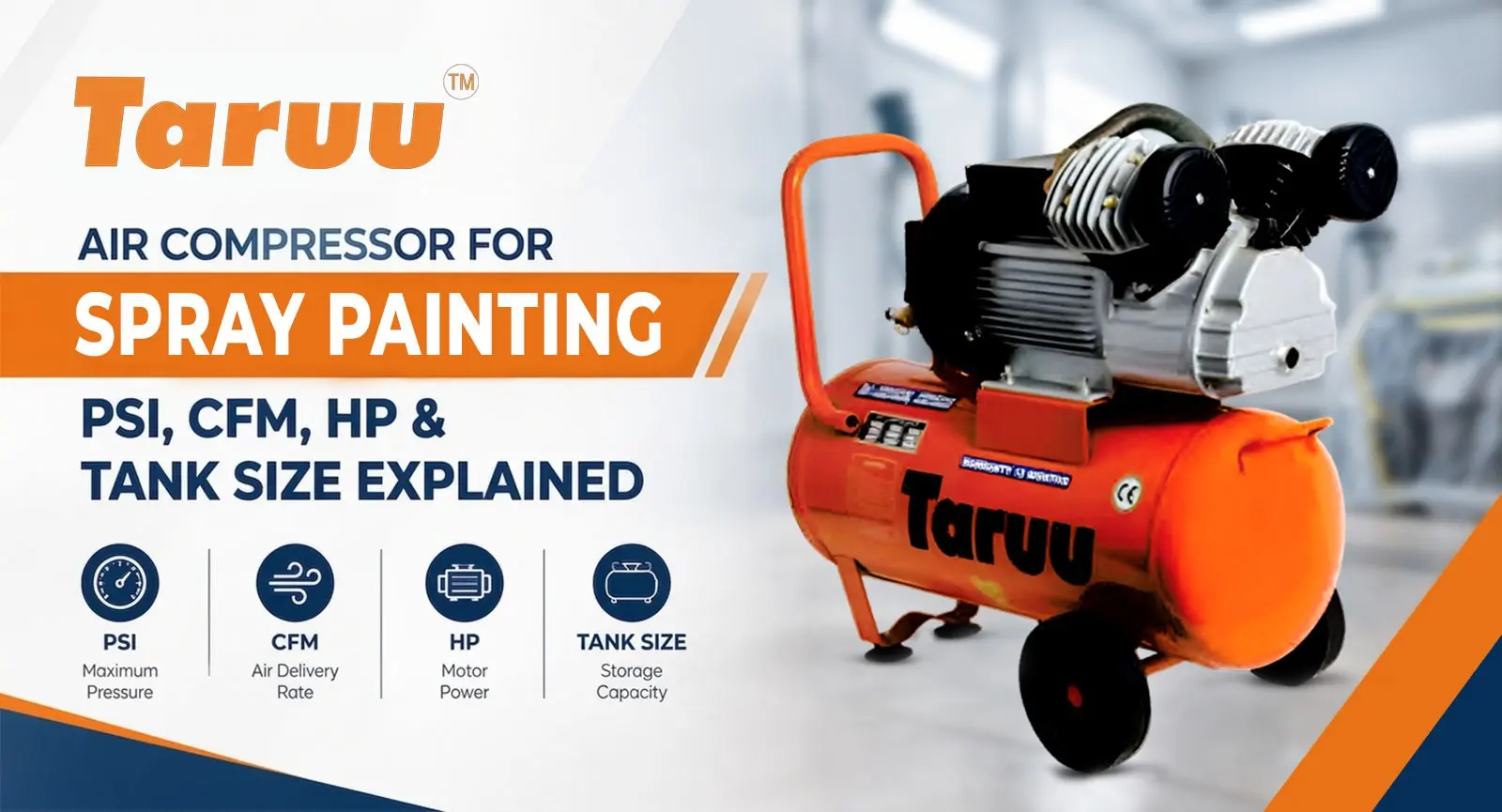
Quick Summary: Spray painting asks more of an air compressor than most other pneumatic tools, mainly because the gun draws air continuously instead of in short bursts. This article is all about what PSI, CFM, HP, and tank size mean for spray painting, how these four work together, and what to check before buying from a spray painting air compressor manufacturers.
Table of Contents
- Introduction
- Why Spray Painting Is Harder on a Compressor Than Other Air Tools
- CFM: The Factor That Decides Whether Your Finish Looks Clean
- PSI: Why Lower Pressure Often Works Better in a Spray Painting Air Compressor
- Horsepower: What It Tells You and What It Doesn't
- Tank Size: Buffering Against Pressure Drop
- Matching a Compressor to Your Spray Gun
- Conclusion
Introduction
A spray painting air compressor isn’t just a bigger version of the compressor available in most garages for tires and nail guns. It has to keep up with a spray gun that pulls air non-stop for as long as the trigger stays down, and that single requirement changes what actually matters when you’re buying one. There are four factors that decide whether a compressor can handle that work properly; these are PSI, CFM, HP, and tank size. Each one tells you something different, and none of them means much on its own. A high PSI rating won’t save you if CFM output drops mid-spray. A big tank won’t help if the horsepower behind it can’t refill fast enough. This article goes through what each of these four factors controls for spray painting, how they work together, and what to check before choosing equipment from a spray painting air compressor manufacturer.
Why Spray Painting Is Harder on a Compressor Than Other Air Tools
Most pneumatic tools work in short, repeated bursts. A nail gun fires, the compressor recovers, and it fires again. A spray painting air compressor doesn’t get that same recovery window. The gun draws air the entire time the trigger is held, often for several minutes straight across a panel or a wall section, which means the compressor has to deliver its full rated output continuously rather than in brief spikes.
Air tool charts are built around a 25 percent duty cycle, which means that the tool works in short bursts with plenty of rest in between. Spray guns don’t rest, so that assumption falls apart. Even a compressor rated for the same CFM as your gun can still come up short once hose losses and normal wear start pulling its output down.
CFM: The Factor That Decides Whether Your Finish Looks Clean
CFM, or cubic feet per minute, measures how much air the compressor delivers, and it’s the number that matters most for spray painting. Conventional and gravity-feed guns typically need somewhere between 4 and 9 CFM, while HVLP guns, which trade pressure for volume to cut overspray, usually need 8 to 15 CFM depending on the nozzle size and gun model.
The mistake most buyers make is matching CFM exactly to the gun’s rating instead of exceeding it. A gun rated for 10 CFM needs a compressor capable of noticeably more than that once hose length, fittings, and normal output decay are factored in; otherwise, the gun runs lean partway through a work, and the finish shows it.
PSI: Why Lower Pressure Often Works Better in a Spray Painting Air Compressor
PSI measures pressure, and spray painting is one of the few applications where more isn’t automatically better. HVLP guns are built to atomize paint at low pressure, typically 25 to 30 PSI at the air cap, occasionally up to 40 PSI for tougher coatings. Pushing pressure higher than the gun calls for doesn’t improve finish quality. It usually increases overspray and wastes material instead.
What matters is the compressor’s ability to hold that target PSI steady while CFM is being drawn continuously. A compressor rated for 90 PSI at rest can still sag well below what the gun needs once air is flowing non-stop, which is why PSI and CFM have to be considered together rather than as separate numbers on a spec sheet.
Horsepower: What It Tells You and What It Doesn’t
Horsepower is one of the most important factors, but it’s really just an input to CFM output rather than a performance number on its own. A 1 HP compressor typically produces around 4 to 5 CFM at 100 PSI, so for most HVLP work, a 3 to 5 HP unit is a more realistic starting point, especially for larger panels or continuous production runs.
The detail worth remembering is that two spray painting air compressors with the same horsepower can deliver noticeably different CFM depending on how efficiently the pump is designed. HP is a useful shorthand when comparing similar models from the same spray painting air compressor manufacturer, but it shouldn’t replace checking the actual CFM rating at your working PSI.
Tank Size: Buffering Against Pressure Drop
Tank size doesn’t generate air, but it takes time before the compressor has to keep up on its own. A larger tank, generally 30 gallons or more for heavy HVLP work, stores reserve air that absorbs the initial draw when the trigger is pulled, smoothing out the pressure drop that a smaller tank can’t cushion.
A tank under 10 gallons can still get the work done. For anything continuous, automotive panels, furniture runs, or larger wall sections, an undersized tank forces the compressor to run near-constantly just to keep pace, which shortens its working life and increases the odds of a mid-work pressure drop.
Matching a Compressor to Your Spray Gun
Getting the right spray painting air compressor is all dependent on checking four numbers together rather than any single one in isolation. These are the things that one should consider:
- Check your gun’s CFM rating first, then size the compressor to exceed it by at least 20 to 30 percent to account for hose losses and normal wear.
- Confirm the PSI range your gun needs, since most HVLP guns want 25 to 30 PSI rather than maximum available pressure.
- Use horsepower as a rough filter, not a final decision, and verify the compressor’s actual CFM output at your working PSI.
- Size the tank to your work length, with larger tanks favoring continuous work over quick touch-ups.
Once these four line up, the compressor stops being something you have to think about for your work.
Conclusion
Buying an air compressor for spray painting doesn’t have to be confusing once you know what PSI, CFM, HP, and tank size actually do. CFM keeps the gun fed with air, PSI keeps the spray even, HP powers the setup, and the tank buffers things when the trigger stays down. Get these four right together, and the compressor stops being a problem. Taruu builds spray painting air compressors that hold steady air, so every coat comes out smooth and consistent.
FAQs
What CFM do I need for an HVLP spray gun?
Most HVLP guns need between 8 and 15 CFM depending on nozzle size, and the compressor should be sized to exceed that rating rather than match it exactly.
Is higher PSI better for spray painting?
No, usually they are not preferred for spray painting. Most HVLP guns perform best around 25 to 30 PSI, and pushing pressure higher usually increases overspray without improving the finish.
What size air compressor tank is best for spray painting?
A 30-gallon tank or larger is perfect for continuous work like automotive panels or furniture runs, while smaller tanks under 10 gallons work fine for quick touch-ups.
How much horsepower does a spray painting compressor need?
For most HVLP applications, 3 to 5 HP is a basic starting point, though the CFM output at your working PSI matters more than the HP rating alone.
Why does my compressor struggle even though it meets my gun's CFM rating?
Hose length, fittings, and normal output decay over time all reduce effective CFM, so a compressor should exceed the gun’s rated requirement, not just match it.
Can a single-stage compressor handle HVLP spray painting?
Single-stage units work for lighter, intermittent work, but continuous work like vehicle panels or large surfaces generally needs a two-stage compressor for reliable output.